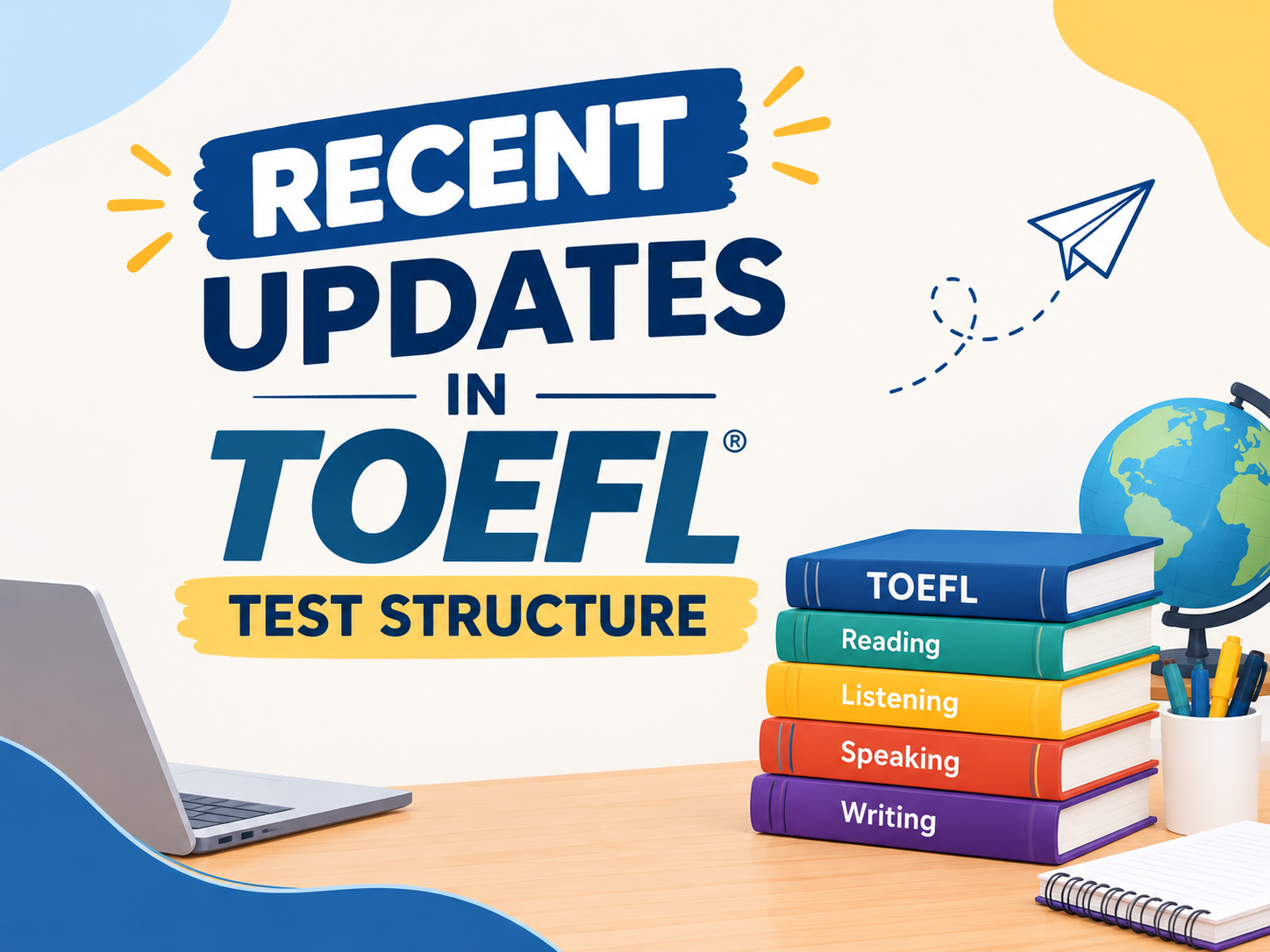
A New Test Format, Updated Question Types and a Revised Scoring System
The TOEFL iBT test introduced significant updates on 21 January 2026, bringing changes to its question types, test structure, adaptive testing approach and scoring system. These updates aim to assess English proficiency through tasks that reflect how students communicate in academic and everyday situations.
For students planning to study abroad, understanding these changes is essential for choosing the right preparation materials and meeting university admission requirements.
What Has Changed in TOEFL iBT?
1. Adaptive Testing in Reading and Listening
The updated TOEFL iBT uses multistage adaptive testing in the Reading and Listening sections. The difficulty of subsequent test material adjusts according to the candidate's performance, creating a more personalised assessment experience.
2. Updated Question Types Across All Four Sections
The revised TOEFL iBT includes new task types designed to assess a wider range of language skills.
Reading
Complete the Words
Read in Daily Life
Read an Academic Passage
Listening
Listen and Choose a Response
Listen to a Conversation
Listen to an Announcement
Listen to an Academic Talk
Writing
Speaking
Listen and Repeat
Take an Interview
Candidates should practise these updated tasks using preparation resources designed specifically for the 2026 test format.
3. A New TOEFL Scoring System
The updated TOEFL iBT introduced a 1–6 scoring scale in half-point increments, aligned with the Common European Framework of Reference for Languages (CEFR).
Candidates receive individual scores for Reading, Listening, Writing and Speaking, along with an overall score calculated by averaging the four section scores and rounding to the nearest half point.
During the two-year transition period, which runs through January 2028, score reports also include a comparable overall score on the previous 0–120 scale. This helps universities and candidates interpret results across the two scoring systems.
4. Revised Test Duration
The updated TOEFL iBT takes approximately two hours, excluding directions. The actual number of questions and timing may vary because Reading and Listening use adaptive testing.
This format is designed to provide an efficient testing experience while assessing candidates across all four English-language skills.
5. Faster Score Reporting
ETS reports that TOEFL iBT scores are generally available within approximately 72 hours of the test. Candidates should check their ETS accounts for their individual score-release dates and allow sufficient time for university application deadlines.
6. Available Test-Taking Options
Candidates can take TOEFL iBT in the following formats:
TOEFL iBT at a Test Centre: The test is completed on a computer at an authorised test centre.
TOEFL iBT Home Edition: The test is completed on a computer at home under live remote supervision, subject to applicable requirements.
The TOEFL iBT Paper Edition was discontinued in January 2024 and is not a current testing option.
How Should Candidates Prepare for the Updated TOEFL iBT?
To prepare effectively, candidates should:
Familiarise themselves with all the revised question types across the four sections.
Practise adaptive Reading and Listening tasks.
Develop sentence construction, email writing and academic discussion skills.
Practise listening-based repetition and interview-style Speaking tasks.
Understand the new 1–6 scoring scale and check the requirements of their target universities.
Stay Updated: Visit the official ETS TOEFL website for the latest test information, preparation resources, scoring guidance and registration details.
Official References:
 Plastic Book Bags
1 ×
$940.00
 The Genie Mind
1 ×
$899.00
 The Energy Book
1 ×
$756.00
 Pencil Bag
1 ×
$723.00
 Sharpner
1 ×
$1080.00